
"Will You Dance?"
(reflections based on Matthew 11:16-19, 25-30)

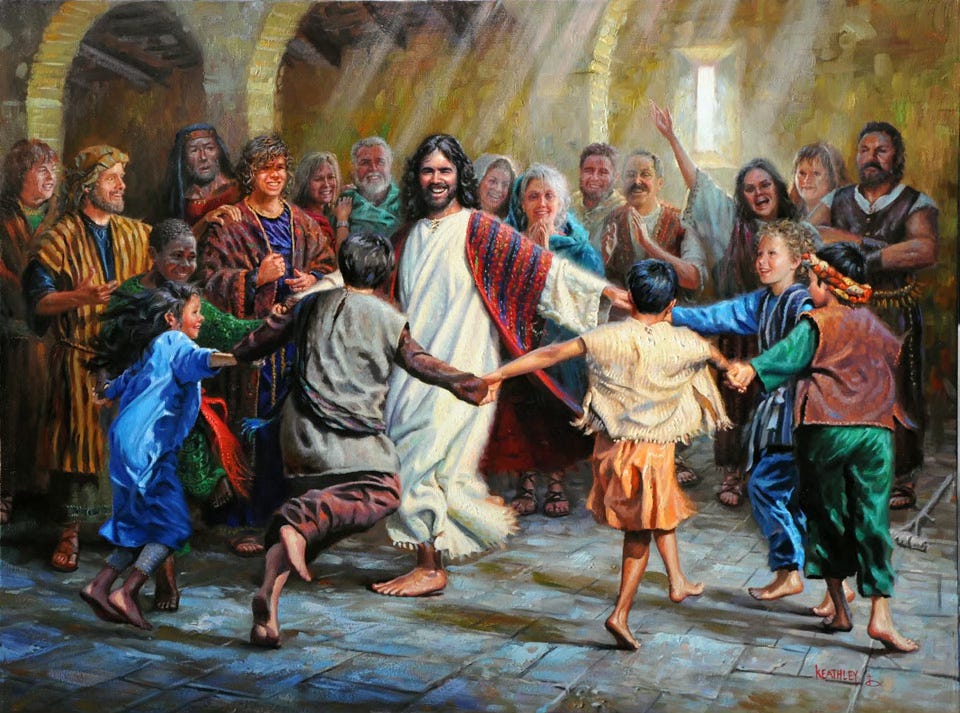
(image: Dance of Grace by Mark Keathley)
I don’t know how many of you have seen the film Chocolat. It’s set in a small French village during Lent. The mayor has turned Lent into a season of rules, restraint and respectability. Everything has become grey.
Then a woman named Vianne arrives and commits the unthinkable: she opens a chocolate shop in the middle of Lent. Her chocolate isn’t simply about sweets. It becomes a symbol of joy. Slowly, the villagers begin to laugh again, welcome strangers, mend relationships, dance and rediscover what it means to be fully alive.
As I read today’s Gospel, that film came to mind. Because Jesus is speaking into a world where many people experienced religion not as life-giving, but as heavy and exhausting.
Jesus begins with a strange little parable about children in the marketplace.
“We played the flute for you, and you did not dance;
we wailed, and you did not mourn.”
He is describing a generation that refuses to respond to God’s invitation, whatever form it takes.
John the Baptist came living in the wilderness - camel hair, wild honey, locusts, a prophet calling people to repentance with urgency and passion. People said he was too extreme.
Then Jesus came eating at people’s tables, celebrating weddings, sharing meals with tax collectors and sinners, announcing God’s mercy and welcome. People said he was a glutton and a drunkard, not spiritual enough.
It didn’t matter whether God came weeping or dancing - they refused to listen.
Whenever I hear the words of Jesus saying, “We played the flute for you, and you did not dance,” it reminds me of Sydney Carter’s lively song, Lord of the Dance:
“I danced for the scribe and the Pharisee,
but they would not dance and they wouldn’t follow me.”
Carter understood something profound. Jesus doesn’t simply teach truth. He invites people into life. Into relationship. Into joy. Into God’s great dance of grace.
And the tragedy is not that people break the rules. The tragedy is that they become so preoccupied with the rules that they miss the music.
Jesus thanks God that the kingdom has been revealed not to the wise and the powerful, but to “little children.” Not because children know more. Quite the opposite. Children are still capable of wonder. They can still welcome surprise. They can still hear music and instinctively move toward it and respond to it.
Recognising what love looks like is not actually complicated. We often make it complicated. But Jesus says the deepest wisdom is received as a gift, not achieved as a status.
And so, throughout the Gospel, the people who recognise Jesus are often not the obvious candidates. Some are educated, many are not. Some are respected, many are not. Many are the overlooked, the ordinary, the weary, the people carrying burdens.
To them, Jesus says:
“Come to me, all you who are weary and are carrying heavy burdens,
and I will give you rest.”
These are some of the most beloved words in Scripture.
Jesus says, “My yoke is easy.” But the Greek word Matthew uses carries the sense of something kind, gracious, well-fitting. Jesus is not placing another burden on exhausted shoulders. He is removing the burdens others have piled upon them.
Religious systems can become heavy. Expectations can become heavy. The endless pressure to prove ourselves worthy can become heavy. Jesus offers something different: a relationship in which we walk beside him and learn from one who is gentle and humble in heart.
God’s grace is not about being perfectly disciplined or intellectually elite. It is more like a child who moves to the music, who welcomes being surprised, who discovers that life with God is not an anxious performance but a gift.
So perhaps the question this Gospel asks is surprisingly simple:
Will you dance?
Will you allow yourself to be surprised by grace?
Will you lay down the exhausting burden of trying to prove yourself worthy?
Will you trust that God’s love comes not as another rule to obey, but as an invitation into abundant life?
There will always be voices telling us we are not disciplined enough, not spiritual enough, not knowledgeable enough, not worthy enough.
Jesus says something entirely different:
“Come to me. All you who are weary. Come. Learn from me. Walk beside me. My yoke is kind. My burden is light.”
And perhaps, just perhaps, we will discover that the kingdom of God has always sounded less like marching in step and more like learning to dance.