
The Blessing of Unity
Psalm 133 through the lens of decolonisation of oikoumene

I’m reflecting on Psalm 133 (RCL reading for 16th August) through the lens of Christian unity, ecumenism, oikoumene and decolonisation.
Perhaps I have understood unity too narrowly.
What follows is a brief reflection on the psalm and then a separate but related reflection on ‘decolonizing oikoumene’.
(And this could also be an interesting dialogue with the Gospel reading this week about Jesus’ encounter with the Canaanite woman)
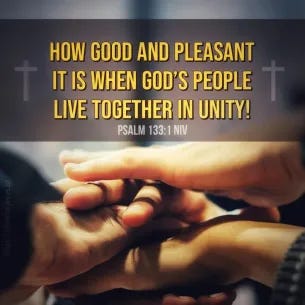
The Blessedness of Unity (NRSVUE) A Song of Ascents.
1 How very good and pleasant it is when kindred live together in unity!
2 It is like the precious oil on the head, running down upon the beard,
on the beard of Aaron, running down over the collar of his robes.
3 It is like the dew of Hermon, which falls on the mountains of Zion.
For there the Lord ordained his blessing, life forevermore.
We often hear these words as a description of Christian unity:
“How good and pleasant it is when kindred live together in unity.”
Churches that have been divided come together.
We worship together. We share our gifts.
We overcome denominational boundaries.
All of that is true.
But decolonial thinking asks us to go one step deeper.
What if unity isn’t the same thing as sameness?
A colonial model of unity can unconsciously say:
We will all come together - and eventually we will all understand things in the same way.
A decolonial model says:
We come together without requiring everyone to become like us.
That’s a profound difference.
The psalm gives two completely different images of unity, and speaks about where the blessing comes from.
Oil flows downward (v. 2)
Oil poured on Aaron’s head, running down his beard, down onto his robes.
There is a hierarchy in that image.
The oil begins at the head and flows downward.
Read traditionally, that’s the anointing of the priest.
But through a decolonial lens, it can invite a question:
Where does authority flow from in our churches?
Much of the Christian tradition has inherited ways of thinking about authority in which theological wisdom flows from recognised centres towards the margins.
From those who are regarded as authoritative to those expected to receive.
From the theological centre to the margins.
From church leaders to people.
From seminaries to congregations.
From European theological traditions to churches in Africa, Asia, the Pacific and Indigenous communities.
From those with institutional authority to those whose knowledge has historically been regarded as “contextual” rather than genuinely theological.
That doesn’t mean the image of anointing is itself colonial. It certainly doesn’t.
But it gives us a wonderfully provocative question:
Does our understanding of unity still imagine wisdom flowing from the head downward?
And then comes the dew (v.3)
The second image is completely different.
It is like the dew of Hermon, which falls on the mountains of Zion.
Here the movement isn’t down in a hierarchy. It is across geography.
Mt Hermon is in the north; Zion is in Jerusalem.
The dew of Hermon falls on Zion.
The psalm brings together places that are geographically distant and symbolically significant. Blessing comes from another place. It crosses boundaries, including those we have constructed. It arrives from somewhere we may not have expected.
Unity doesn’t have to mean that everything flows from one centre.
Perhaps God’s blessing comes from unexpected places.
Perhaps the church in Africa has something to teach the church in Australia.
Perhaps the Pacific churches have something to teach churches in Europe about creation.
Perhaps Indigenous Christian theology has something to teach settler churches about land, relationship and community.
Perhaps churches that Western Christianity has historically regarded as “younger” or “developing” actually possess theological wisdom that Western churches desperately need.
The dew comes from Hermon to Zion. The blessing of God does not always come from the places we have assumed are the centre. The blessing doesn’t stay where we expect it to stay. What if the blessing of God is already flowing among us - but we have sometimes been standing in the wrong place to receive it?
Psalm 133 doesn’t have to be read simply as “unity is good and pleasant.”
It can become a question: What kind of unity? Who gets to define it?
Whose voice determines what counts as unity?
There is a temptation, particularly in ecumenical organisations, to think that our task is to hold everyone together.
But Psalm 133 says something more radical. God gives the blessing.
We don’t manufacture unity. We don’t own it. We don’t control it.
The oil flows. The dew falls.
And then: There God commanded the blessing: life forevermore.
Perhaps the task isn’t to create unity but to make room for the unity God is already creating.
And that changes the posture of leadership.
Less: How do we get everyone to agree?
More: Whose voice have we not heard?
Less: How do we bring these people into our ecumenical conversation?
More: What if the conversation needs to change because of what they bring?
Less: How do we preserve the ecumenical tradition?
More: What must we relinquish so that the ecumenical tradition can become more fully what it claims to be?
Henri Nouwen insists on a certain type of inner poverty: a poverty of mind and heart: “Someone who is filled with ideas, concepts, opinions and convictions… has no inner space to listen, no openness to discover the gift of the other.”
The World Council of Churches’ description of the ecumenical vocation speaks about being prepared to listen, learn and decide with people from different contexts, cultures, languages and expressions of faith. It says that being ecumenical means recognising that there is one oikoumene but diverse habitations.
That phrase - diverse habitations – is an important lens for Psalm 133.
The psalm doesn’t say: How good it is when everyone thinks alike.
It says: How good it is when people dwell together.
Dwelling together is much more demanding than agreeing.
It means making a home together.
It means learning how to inhabit the same space without one person’s way of being becoming the norm for everyone else.
Not unity achieved by making everyone the same, but communion made possible when different peoples are able to dwell together without one becoming the measure of the other.
Unity doesn’t erase difference.
It makes space for difference to live together.
The question for us is not simply, How can we create greater unity?
Perhaps it is: Whose blessing have we not yet learned to recognise?
Perhaps this is one of the gifts of Psalm 133 for the ecumenical church today. Unity is not about everyone becoming the same. It is about learning to dwell together, making room for one another’s wisdom, and becoming attentive to the places from which God’s blessing may come.
Maybe the Spirit is already bringing us together.
Our task is to notice where the dew is falling.
Here’s Part 2 that grew out of the reflection on Psalm 133
Decolonizing oikoumene
The ecumenical movement has always had a tension within it. On the one hand, oikoumene means the whole inhabited earth. The ecumenical vision is therefore extraordinarily expansive: God’s people across cultures, languages, nations and traditions, seeking one another, learning from one another and working together for the healing of creation.
The World Council of Churches describes ecumenism as embracing Christian unity, common witness, justice, peace and the healing of the human community.
On the other hand, the modern ecumenical movement emerged largely through Western missionary Christianity. The 1910 Edinburgh Missionary Conference is commonly regarded as a significant starting point for the movements that eventually became the WCC. And missionary Christianity was deeply entangled with European colonialism.
So there is a difficult question. Can a movement committed to the unity of the whole inhabited earth still carry assumptions about whose theology, language, structures and ways of knowing are normative?
That is the heart of decolonising ecumenism.
The World Council of Churches is explicitly engaging in this question. In June 2026 it held an international colloquium entitled “Decolonizing Ecumenical Hermeneutics,” acknowledging that ecumenical theological discourse has historically privileged Eurocentric frameworks while marginalising communities shaped by colonial histories and Indigenous worldviews. It has explicitly named the possibility of “a decolonized world” within its vision for unity, justice and peace. The World Council of Churches has described the need to dismantle the Eurocentrism of mission and ecumenism, and its recent work on “decolonial discipleship” explicitly addresses the way mission has been entangled with colonial possession.
If we take decolonising ecumenism seriously, then Australian ecumenism has to ask:
What happens when the oldest continuing cultures on this continent are not treated merely as recipients of Christian ministry, but as people from whom the church might receive theological wisdom?
This question therefore moves beyond:
“How can the churches engage respectfully with First Peoples/Aboriginal Peoples?”
towards:
“What might First Peoples/Aboriginal Peoples teach the churches about God, creation, community, belonging, country and relationship?”
(quick side note with use of ‘First Nations’ terminology – Uncle Glenn Loughrey says this is an import from the USA and we need to be explicit in saying Aboriginal and Torres Strait Islander peoples)
This question provides a profound theological shift.
And it is exactly the kind of shift that decolonisation invites:
from speaking about people to listening to people
from bringing knowledge to receiving knowledge
from being the centre to recognising that there may be many centres.
Historically, oikoumene (the whole inhabited earth) has complicated imperial associations. The concept of the oikoumene developed in worlds where “the inhabited world” could effectively mean the world known or controlled by an empire.
So perhaps decolonising the oikoumene means asking:
Whose “whole world” are we talking about?
Because there is a danger that “worldwide Christianity” can unconsciously mean:
Western Christianity … plus everyone else.
Whereas the truly ecumenical vision should mean:
the whole body of Christ, in all its cultural, theological, geographical and Indigenous diversity, listening to one another.
Not centre and periphery.
Not giver and recipient.
Not teacher and learner.
But mutuality.
Not sameness. Not conformity. Not one centre from which everything flows.
But dwelling together, listening, receiving, and being surprised by where God’s blessing appears.
Recently I went to the installation of Bishop René Ramirez, the new Catholic Bishop in the Diocese of Sandhurst. He is from the Philippines, but has lived in Melbourne for a long time. I was so excited to attend his installation and quietly expectant about what he might bring to the Diocese - not simply as a new bishop, but as someone shaped by another culture and another expression of the Christian story. In what ways will he bring his whole cultural and theological self into the life of the church? As he said, ‘My story now becomes part of your story’. Will we listen? Will we be prepared to receive what he brings? Will his cultural diversity be welcomed while expecting him to fit comfortably into the way things have always been done?
We are seeing something similar in the Uniting Church, where our current national President comes from a Tongan cultural background, our President-elect comes from South Korea, and the Vic/Tas and NSW/ACT Moderators come from a Pacifika background. We rightly celebrate this diversity, reflecting a more genuinely global church. But perhaps there is a deeper question: are we simply making room for people from different cultures within our existing structures, or are we allowing their presence to reshape our understanding of church, leadership and community?
Are we allowing diversity to change the way the church understands itself?
Diversity isn’t the same as decolonisation.
A church can have a wonderfully diverse leadership team while the structures of authority, theological assumptions and decision-making remain essentially unchanged. Even a relatively non-hierarchical church can carry Western cultural assumptions about theology, education, leadership, governance and what “good church practice” looks like.
Decolonisation asks a harder question.
What happens when the person who has come from another cultural tradition doesn’t simply occupy the existing role, but brings another way of understanding leadership, community, worship, authority, theology and relationship?
Do we listen? Do we adapt? Are we curious?
Or do we unconsciously expect the new leader to fit themselves into the existing ecclesial culture? That is the difference between representation and transformation.
We don’t need to romanticise or champion any culture or tradition. Every tradition has gifts, blind spots, histories and internal complexities. The ecumenical vocation is precisely to encounter one another deeply enough that our own blind spots can be revealed.
Perhaps decolonising ecumenism means becoming humble enough to recognise that God’s wisdom is not located in one culture, one tradition, one theological system or one centre of power. Perhaps the gift of ecumenism is not that we bring everyone into our way of understanding the church, but that we discover that Christ has been present and speaking in ways we had not yet learned to hear.
Whose voice have we welcomed - but not yet really listened to?
Whose wisdom have we celebrated - but not yet allowed to change us?
The ecumenical movement is from certainty to curiosity, from centrality to mutuality, from representation to reciprocity, from “we welcome you” to “we need what you bring.”
The deeper invitation, then, is to ask where power has accumulated, whose knowledge has been privileged, whose has been marginalised, and whether we are genuinely open to being changed by one another.
We do not expect people in the church to be culturally neutral. Rather, the invitation is for people to bring their particularity - Tongan, Korean, Filipino, Indigenous Australian, African, European, Anglo-Celtic, Pacific - where those particularities are not obstacles to unity but gifts to the whole body.
That is a very different vision of oikoumene.
Because the church doesn’t become truly oikoumene merely when more kinds of people are inside the room. It becomes more truly oikoumene when the room itself begins to change because they are there.