
A parable - sowing seeds
First thoughts on a sermon for Matthew 13:1-9,18-23

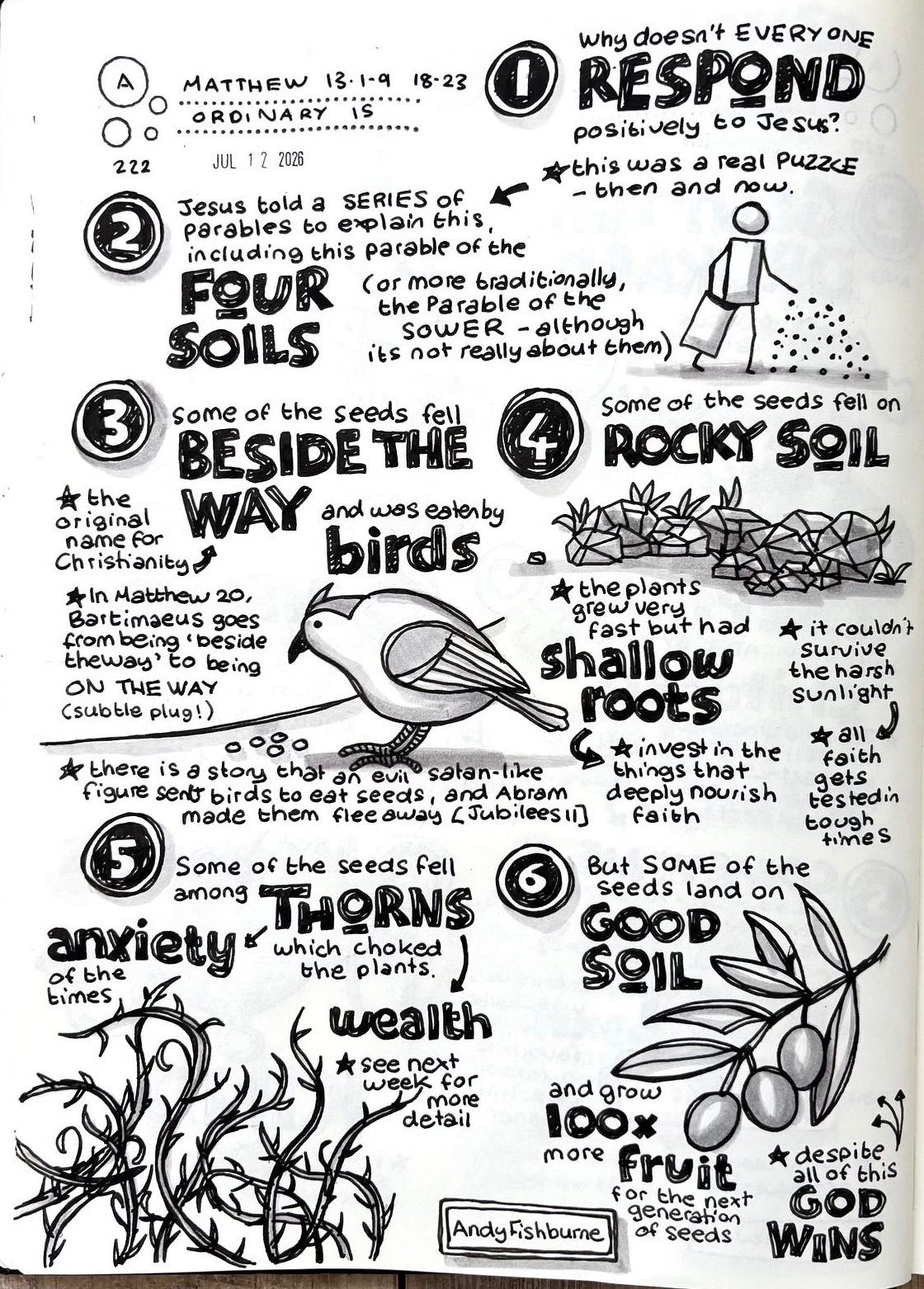
By this point in Matthew’s Gospel, there was a growing distinction between the disciples, who had embraced Jesus and his ministry, and those who challenged or rejected Jesus. The parables in Matthew 13 are bookended by the Pharisees conspiring to destroy him (eg 12:14) and the people of his hometown rejecting him (13:54–58). This parable sits right in the middle of this heavy opposition - and rejection.
Rather than slowing his ministry or using caution in the face of these threats, Jesus redefines how the reign of God will advance by sharing a story of patience and perseverance.
A sower goes out to sow…
Any careful farmer would avoid the rocky ground.
They would avoid the path.
They would avoid the thorn bushes.
Seed was precious. You didn’t waste it.
Yet this sower generously scatters seed everywhere.
On good soil and poor ground.
On places where it will flourish and places where it will struggle.
The sower refuses to ration generosity.
Perhaps that is how God has always been.
God does not carefully measure out grace only where success seems guaranteed.
God keeps sowing. Again and again.
Into every human life. Into every community. Into every generation.
Even into places that appear hard, resistant or forgotten.
If you’re a gardener you’ll know that other rogue seeds can blow in, and grow and take hold. Weeding, the bane of every gardener, though there’s a certain kind of satisfaction on a newly weeded patch.
Our lives are constantly receiving seeds.
Some come from God.
Others do not.
Every day voices compete for our attention.
Seeds of fear.
Seeds of resentment..
Seeds that tell us some people belong while others do not.
Seeds that encourage us to protect ourselves rather than love our neighbour.
We do not have to look very far to find them.
Our news.
Our social media.
Political rhetoric.
Conversations that quietly diminish the dignity of others.
Someone is always sowing something.
The question is not whether seeds are being scattered.
The question is which seeds we allow to take root in our lives, in our communities, in our world. And in our churches.
Perhaps it is one of the great dangers for the Church.
We can suffer a kind of spiritual amnesia.
We forget what first grew within us.
The Apostle Paul describes the fruit of God’s Spirit as love, joy, peace, patience, kindness, generosity, faithfulness, gentleness and self-control.
These are the fruits the Gospel is meant to produce.
And yet, if we are not careful, other plants quietly begin to grow.
Division. Discontent. Bitterness. Fear.
The need always to be right.
The suspicion of those who are different from us.
Slowly another crop can take over the field.
Sometimes even using language familiar to us.
Recently we have heard the revival of public rhetoric about ‘Judeo-Christian’ values. It’s not a new thing. It’s coded language to elevate one cultural perspective over others. Sometimes it builds on the advantage of unexamined privilege that some have in our communities - while denying that privilege to others. The language is designed as a warning that the ‘western way of life’ is under siege from “those coming into this country and bringing with them the troubles they have left behind”. Accusations are made about newcomers to this country having ideas that are apparently incompatible with Australian values.
Couple this rhetoric with the real challenges people are facing – housing, job insecurity, cost of living pressures – and it’s easy to see why this kind of framing has appeal, including to Christians.
I was interested to read comments by the newly appointed ‘mobilisation strategist’ at the ecumenical humanitarian agency Act for Peace, Pastor Jarrod McKenna, who says the term “Judeo-Christian” in public debate does not mean anything that Jesus actually taught. He says, “It is not used to refer to love of neighbour and very rarely refer to welcoming the stranger. If anything, the stranger is used as a scapegoat.” He says the antidote to divisive rhetoric is to prioritise kindness and practical values like a “fair go” which he says is a pretty good Aussie paraphrase of the biblical principle to act justly, love mercy and walk humbly with God.
The invitation of Jesus is to keep opening ourselves to the life God is sowing, and to find the pathways to elevate care, kindness, respect and love among people and communities
One of the great joys in ministry has been to see just how widely the seeds of the reign of God have been scattered. Those seeds have surely travelled far beyond the imagination of those first disciples standing beside the Sea of Galilee listening to Jesus using agrarian parables to talk about the reign of God.
Look at the family that God has grown here in this country. Orthodox Christians from many countries. Palestinian Christians whose heritage reaches back to the earliest followers of Jesus. Syrian, Iranian, Iraqi and Sudanese Christians - to name just a few who have carried their faith through persecution and displacement. Greek and Italian families whose faith became part of Australia’s story. Indian Christians who have come to seek a better life for their families. Refugees from many nations now proudly wearing the green and gold at the World Cup. So many more…
Just in the last week, our Tongan sisters and brothers celebrated two hundred years since the Gospel first took root in Tonga, the seeds of faith shared by early missionaries. We have a Moderator here in Victoria and the national President whose family lineage in Tonga grew from the seeds planted by those early missionaries.
Here in Melbourne we worship alongside Christians whose stories begin in Korea, China, South Sudan, India, Sri Lanka, Zimbabwe, Syria, Iran and Iraq, the Pacific and so many other places. The Uniting Church in Australia (UCA) worships in around 45 distinct languages other than English and embraces members from over 193 specific language and cultural groups. On any Sunday, around 200 congregations within the Uniting Church gather to worship using a language or languages other than English, including in 15 different languages of First Nations people.
Different languages.
Different music.
Different histories.
One Gospel.
One generous Sower.
Unity without uniformity.
Diversity and shared values.
The diversity of the Church is itself testimony to the generosity of God.
May we play our part in building a place of love, kindness, honesty, truthfulness and faith; where everyone is gathered in and finds a place of belonging; where we can all catch hold of God’s vision for us and our world. May it be so. Amen.